Quick answer: Measure your dog lying down from nose to the base of the tail, then compare with our orthopaedic dog bed guide or any bed’s sleeping area. Choose a sleeping area a little longer than your measurement, so your dog can stretch and turn. Curlers suit round beds, and sprawlers suit larger flat beds or mats. For a crate, measure the crate floor, not the dog. If in doubt, size up.
A bed that looked generous in the photo can turn out to be a squeeze once your dog is in it. Getting the size right comes down to two numbers and one habit: your dog’s length and width lying down, and how they like to sleep.
This guide explains how to measure, which shapes suit which sleepers and how to size a crate mat, using the real dimensions of the beds and mats in our shop as examples.
Key takeaways
- Measure from nose to the base of the tail, with your dog lying in their usual sleeping position.
- Compare that with the inside sleeping area, not the outside size. Raised sides take up space.
- If your dog falls between two sizes, choose the larger one.
- Curlers suit round beds, sprawlers suit big flat beds or mats, and leaners suit sofa-style beds.
- For a crate, measure the crate floor, not the dog.
New UK dog guides by email
We send new UK guides about twice a month.
How do you measure your dog for a bed?
Measure your dog’s length and width while they lie down, then add a little room to turn and stretch.
- Wait until your dog is lying down in their usual sleeping position, or ask them to lie down for a treat.
- Measure the length from the tip of the nose to the base of the tail. If your dog sleeps stretched out, measure them stretched out.
- Measure the width across the widest point, including the legs if they tend to stick out.
- Add a little extra room so your dog can turn around, stretch and settle.
- Compare with the sleeping area, not just the outside measurements. Beds with raised sides or bolsters have less usable space than their overall size suggests.
If your dog falls between two sizes, the larger one is usually the safer choice. A bed that’s slightly too big is rarely a problem. One that’s too small often goes unused.
Which bed shape suits how your dog sleeps?
Match the shape to your dog’s favourite position: round for curlers, flat and roomy for sprawlers, and sofa-style for leaners.
| How your dog sleeps | Bed shape | Example from our shop | Sizes |
|---|---|---|---|
| Curled up, nose to tail | Round bed with a raised rim | Round Plush Pet Bed | 40 x 40, 50 x 50, 60 x 60 and 70 x 70 cm |
| Stretched out on their side | Large flat bed or mat | Flannel Pet Sleeping Mat | XS (32 x 25 cm) up to XXL (89 x 68 cm) |
| Leaning against something | Sofa-style bed with raised sides | Dog Sofa Bed | M to XXL (check the size chart) |
| In a crate | Mat that covers the crate floor | Washable Dog Crate Mat | 45 x 90 cm or 60 x 120 cm |
- Curlers. A round bed with a raised rim to lean into suits dogs who sleep curled into a ball. Our Round Plush Pet Bed is a soft faux-fur donut in four sizes, from 40 x 40 cm to 70 x 70 cm. It suits small dogs and cats, and it’s washable.
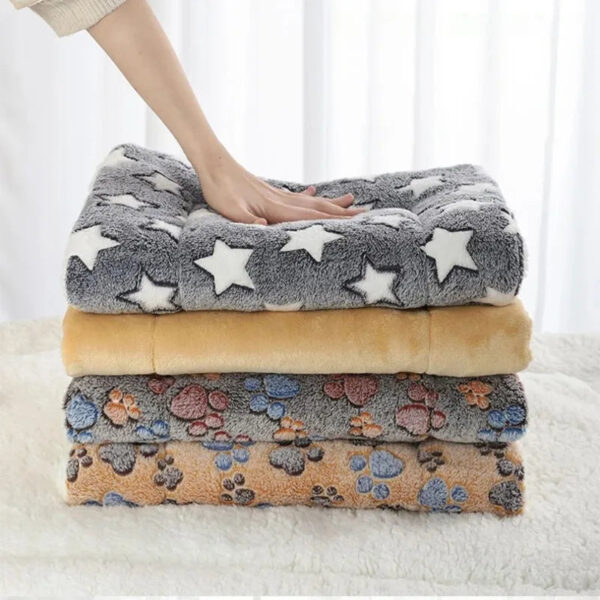
- Sprawlers. Dogs who sleep on their side with their legs out need more length and width, so look at roomier beds or flat mats in the larger sizes. Our Flannel Pet Sleeping Mat goes up to XL (79 x 60 cm) and XXL (89 x 68 cm), and also works on the sofa or in the car boot.
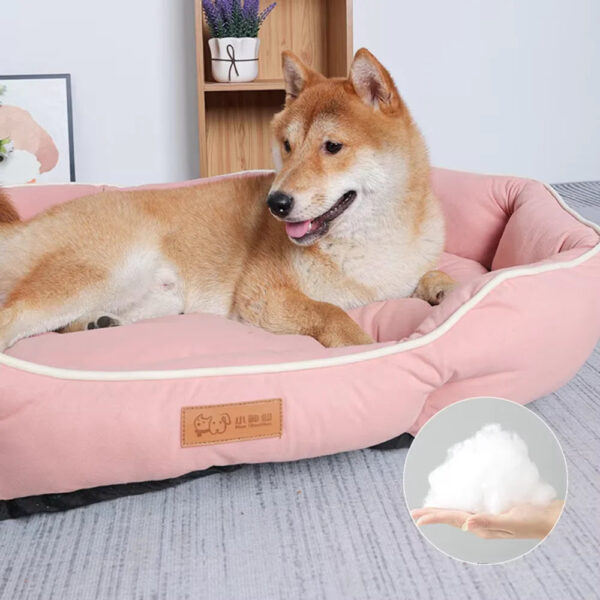
- Leaners. Some dogs like to rest their head or back against something while they sleep, and a sofa-style bed with raised sides gives them that. Our Dog Sofa Bed comes in sizes M to XXL. Check the size chart on the product page against your measurements before you order.
What size bed suits an older or heavy dog?
Use the same measuring method, then look at foam depth as well as size. A bed that’s easy to step onto, with low sides, is often easier for an older dog to use. Our orthopaedic dog bed guide compares five memory-foam and egg-crate beds by size, depth and shape.
If your dog is stiff or slow to get up, ask your vet. The PDSA’s page on arthritis in dogs explains the signs, and Dogs Trust has advice on looking after an older dog.
How do you size a crate mat?
Measure the inside of the crate floor, not your dog, and choose a mat that covers it without bunching up at the edges.
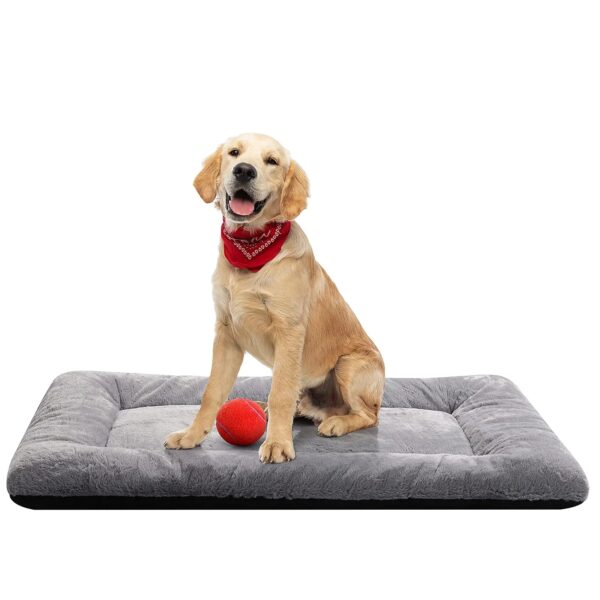
- Medium and large crates. Our Washable Dog Crate Mat comes in 45 x 90 cm or 60 x 120 cm, with an anti-slip base. It suits medium to large dogs.
- Small crates, carriers and baskets. The Flannel Pet Sleeping Mat starts at XS (32 x 25 cm) and runs through S (49 x 32 cm), M (61 x 41 cm) and L (69 x 52 cm).
Still choosing a crate? Our guide to the best dog crates for puppies explains how to size one.
Where should a dog bed go, and how do you keep it clean?
Somewhere quiet and warm, out of the way of people walking past, with a washable cover you can swap out.
- Away from draughts. Keep the bed away from draughty doors and cold, hard floors.
- Off the main route. Avoid the busiest path through the house, so your dog isn’t stepped over.
- Near the family. If your dog likes company, choose a spot where they can still see or hear you.
- Non-slip on hard floors. On laminate or tiles, check the bed doesn’t slide when your dog steps onto it.
In winter, a cushioned bed off a cold floor gives your dog a warm spot, and our guide to keeping your dog warm in winter has more. In summer, some dogs prefer a lighter surface, such as our Dog Cooling Mat, in five sizes from XS (40 x 30 cm) to XL (100 x 75 cm).
For cleaning, choose a washable bed or mat and keep a spare in rotation, so your dog always has a clean, dry place to sleep. Shake out loose hair outdoors before washing, and follow the care label.
Frequently asked questions
Should a dog bed be bigger than the dog?
Yes, a little. The sleeping area should be slightly longer than your dog’s nose-to-tail measurement when lying down, so they can turn around and stretch out comfortably. With bolster or sofa-style beds, compare your measurement with the inside space, because raised sides make the usable area smaller than the outside size.
What size bed does a puppy need?
Puppies grow quickly, so many owners use a washable mat at first and choose a bed for their adult size later. A mat is easy to wash after accidents and easy to replace if it gets chewed. Your breeder or vet can give you an idea of how big your puppy is likely to grow.
What kind of bed suits an older dog?
A bed that’s easy to step onto, with low sides, is often easier for an older dog to use. A non-slip base helps on hard floors, and a flat foam mattress gives them a firm surface to lie on. If your dog is stiff or has joint problems, ask your vet what support would suit them.
Can cats use these beds?
Yes. The Round Plush Pet Bed, the Flannel Pet Sleeping Mat and the Dog Cooling Mat all suit cats as well as dogs. Many cats like to curl into the round bed’s soft raised rim. Use the same method for a cat: measure them lying down and choose a bed slightly larger.
How do you know if a dog bed is too small?
Watch how your dog uses it. Legs or a head hanging over the edge, curling up tightly when they’d normally stretch out, or lying on the floor next to the bed are all signs it’s too small. Measure again with your dog lying in their usual position and size up.
How often should you wash a dog bed?
Wash the cover whenever it looks dirty or smells, and more often in the muddy months or if your dog has skin problems. Shake out loose hair outdoors first and follow the care label. Keeping a second cover or mat in rotation means your dog always has a dry bed while one is in the wash.